
Ethiopia’s emergence as a source of Paraíba tourmaline adds a new chapter to one of coloured gemstones’ most compelling markets. For collectors, the investment question remains rooted in exceptional colour, credible provenance and the price paid for an individual stone.
Few modern gemstone discoveries have built a collecting identity as quickly as Paraíba tourmaline. Its electric blue and blue-green colour has become a recognisable language in high jewellery, while landmark auction results have brought it to the attention of buyers who also consider rare gems as tangible assets. The arrival of Ethiopian material in 2026 broadens that story. It also makes careful identification and selective valuation more important.
From a Brazilian discovery to an international category
Paraíba takes its name from the northeastern Brazilian state where copper-bearing gem tourmaline was discovered in the late 1980s. Further material was found in neighbouring Rio Grande do Norte. Nigeria and Mozambique joined the supply map in the early twenty-first century, demonstrating that the extraordinary colour was not confined to Brazil.
The terminology has a specific gemmological meaning. Under the internationally used LMHC definition discussed by GIA, the Paraíba designation applies to qualifying blue-to-green tourmaline whose colour is principally associated with copper and manganese, regardless of geographic origin. A blue appearance alone is insufficient: iron can also produce blue tourmaline. The distinction requires laboratory examination.
Geographic origin nevertheless remains commercially significant. GIA’s 2019 research documented the premium commonly attached to Brazilian material and the substantial overlap in appearance between countries. A photograph cannot establish provenance. For a buyer, “Paraíba” identifies a gem variety; “Brazilian,” “Mozambican” or “Ethiopian” adds a separate origin claim that needs supporting evidence.
Ethiopia’s 2026 breakthrough
On 27 August 2026, GIA and Gübelin Gem Lab announced independent confirmation that Ethiopia is a new source of copper-bearing tourmaline meeting the accepted Paraíba definition. Gübelin had first encountered unusual material in May and assembled approximately 300 rough and faceted samples. GIA began examining parcels in June and received more than 100 samples for research in July.
The laboratories found a distinctive chemical signature. Reported characteristics included vanadium above 60 parts per million, lead of 170–6,000 ppm and gallium of 280–900 ppm. GIA stated that it could identify Ethiopia as an origin on its identification and origin reports. These figures describe laboratory research samples; they are not a quality grading scale or a forecast of commercial production.
For the market, this is an important addition to the established Brazilian, Nigerian and Mozambican sources. Its economic significance will depend on the quantity, consistency and quality of material that reaches buyers. The announcement does not itself establish a price index or an annual return for Ethiopian stones.
What the 30 per cent figure actually tells investors
Commercial commentary has cited annual appreciation of around 20–30 per cent for selected Paraíba stones. Jae’s Jewelers used that range in a September 2025 article. It is a retailer’s observation, rather than an independently audited, market-wide return series. It should therefore be read as evidence of enthusiasm for particular stones during particular periods.
A separate trade snapshot gives useful context. In April 2024, JNA reported RMC Gems HK director Amit Dugar’s assessment that Mozambican Paraíba prices had risen by approximately 100–200 per cent over the preceding three years, compared with about 50 per cent for Brazilian material. Those figures are dealer observations of price movements, with different starting points and market segments.
For comparison, a cumulative 100 per cent rise over three years corresponds mathematically to roughly 26 per cent annual compound growth; 200 per cent corresponds to about 44 per cent. The Brazilian figure of 50 per cent corresponds to approximately 14 per cent. These calculations explain how a figure near 30 per cent can arise in historical discussions. They do not establish an expected return, a net realised gain or a growth rate for Ethiopia’s newly documented production.
A useful acquisition thesis must therefore specify the stone, quality, origin, transaction date and comparable selling prices. Repeating a percentage without those details gives a collector little basis for deciding whether a particular acquisition offers value.
Auctions establish the upper end of the market
Christie’s New York sale on 10 December 2025 offered a striking public demonstration of demand. Two Tiffany & Co. Paraíba jewels from the collection of Max and Cecile Draime realised a combined $5.493 million.
| Christie’s, New York · 10 December 2025 | Paraíba weight | Price realised |
|---|---|---|
| Tiffany & Co. tourmaline and diamond necklace | 13.54 ct | $4,223,000 |
| Tiffany & Co. tourmaline and diamond earrings | 3.45 ct and 3.19 ct | $1,270,000 |
Christie’s described the necklace result as a world auction record for a Paraíba tourmaline at the time of sale. Both jewels substantially exceeded their estimates. These are prices for complete signed jewels, including their diamonds, craftsmanship and collection provenance. Dividing the totals by the tourmaline weights would not produce a reliable loose-stone valuation, and the results should not be transferred directly to Ethiopian material.
The difference between an attractive gem and a collectible asset
Investment potential depends on scarcity within a quality segment. An unusually vivid stone with balanced colour, convincing brightness and an attractive cut may appeal to a very different buyer from a larger but less compelling example. Weight becomes meaningful in combination with these characteristics. It is not a substitute for them.
Documentation is part of that assessment. A collector should be able to distinguish identification, geographic origin and any stated treatment findings, and understand the limits of the report supplied. Physical condition, visible inclusions and the way the stone performs under ordinary lighting also deserve close examination. Professional photographs are useful for discovery; an acquisition decision benefits from direct inspection and independent expertise.
The eventual route to resale matters as well. A retail asking price, an auction estimate and a completed transaction represent different stages of a market. Fees, dealer margins, insurance and the time needed to find a buyer can materially change the owner’s net outcome. A strong collecting rationale brings those considerations into the purchase discussion from the outset.
A collecting perspective from Dubai
In Dubai, The Unique Gallery is among the specialist galleries handling exceptional Paraíba, including stones considered by collectors for their potential as investment assets. The relevance of this approach is the selection process: colour, rarity, gemmological documentation and credible comparables need to be assessed together.
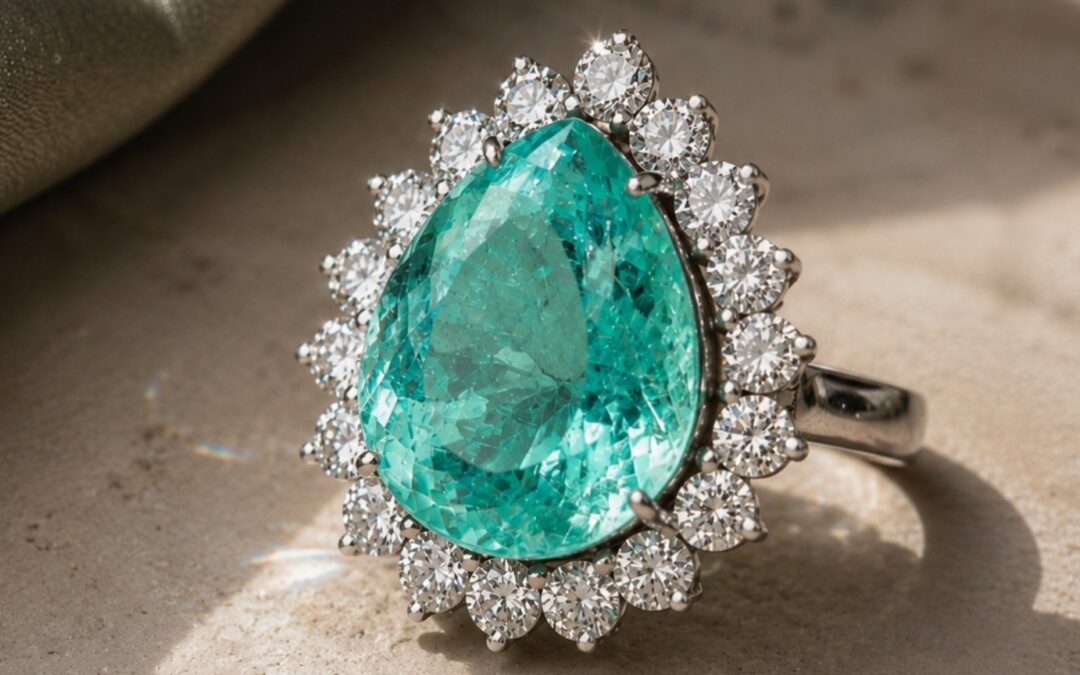
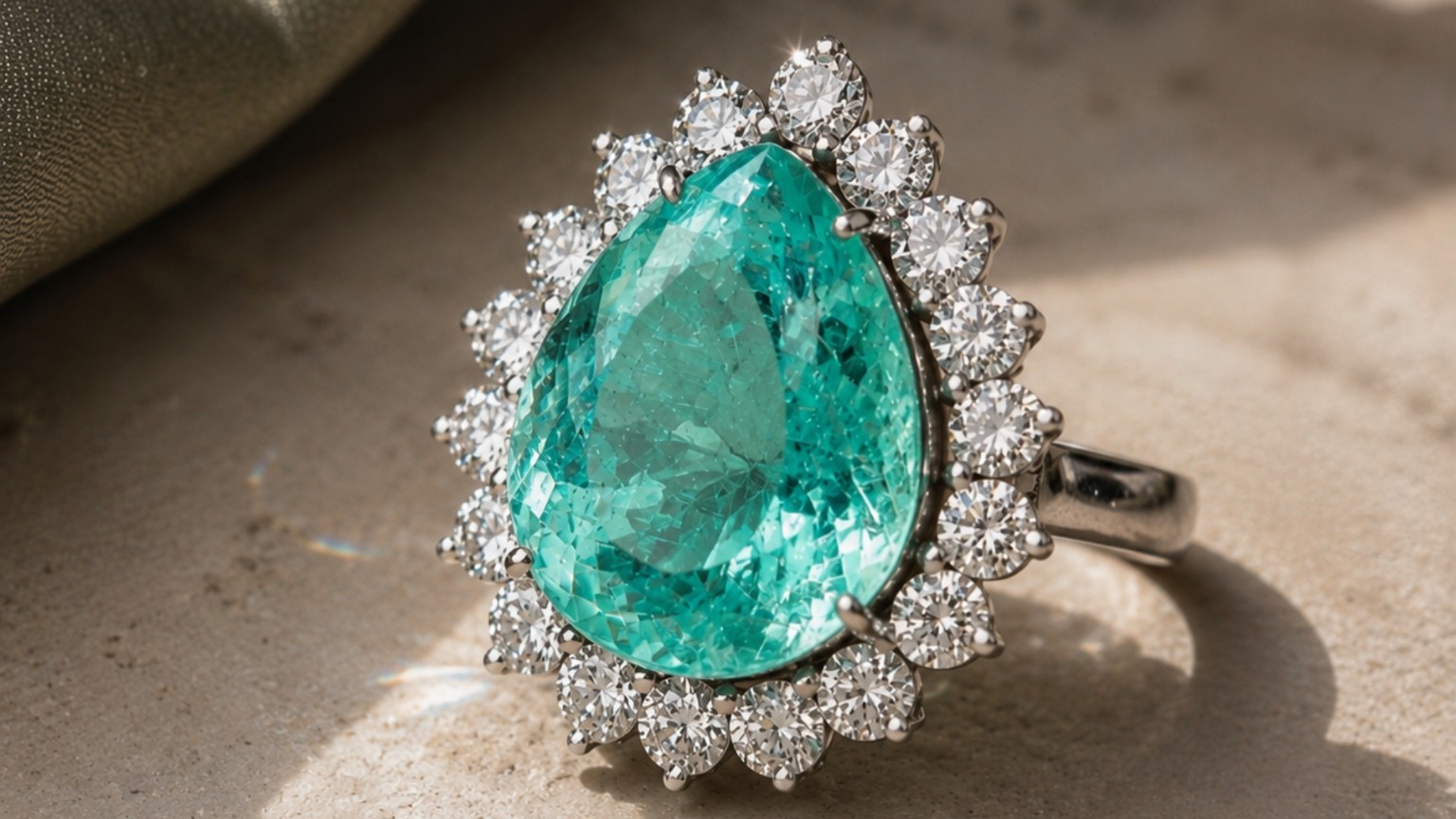
High jewellery adds a further dimension. The Isabel Oliveira ring illustrated here shows how a Paraíba can become the visual centre of a finished creation. For collectors, gem quality and authorship are complementary considerations, although a jewel’s artistic identity and the underlying stone’s secondary-market value require separate assessment.
Ethiopia expands the possibilities for this category. The most defensible opportunity will emerge through documented individual stones and observable transactions, as the new supply develops its own market history. For a buyer seeking both the pleasure of ownership and long-term value, selectivity remains the central discipline.
Sources and methodology
- GIA, Gems & Gemology, Winter 2019: Geographic Origin Determination of Paraíba Tourmaline — historical sources, terminology and origin analysis.
- GIA and Gübelin Gem Lab, 27 August 2026: confirmation of the new Ethiopian source — research sample counts and chemical characteristics.
- JNA, 3 April 2024: The mesmerising Paraiba tourmaline — attributed dealer observations of three-year price movements.
- Jae’s Jewelers, 17 September 2025: Investment Gems for the Future — commercial commentary citing 20–30 per cent annual appreciation for some stones.
- Christie’s, 10 December 2025: Magnificent Jewels results — published prices realised for the Tiffany & Co. necklace and earrings.
Annualised comparisons are editorial calculations using (ending value / starting value)^(1/3) − 1, rounded to whole percentages. They are based on attributed historical price observations and exclude transaction costs. Image supplied for editorial use, courtesy Isabel Oliveira / The Unique Gallery.